blog post
Designing for Durability: Materials and Finishes That Last in the NCR Climate
In the world of high-end architecture, the National Capital Region (NCR) serves as a brutal testing ground. Between the scorching dry heat of May, the intense humidity of the monsoon, and the sharp winter chill, a home in Delhi or Gurgaon has to endure some of the most dramatic weather shifts on the planet.
For many homeowners, the initial charm of a new design often fades when surfaces start to warp, paint begins to flake, or expensive finishes lose their luster under the relentless sun. At Interia, recognized as the best interior design company in India, we believe that true luxury is inseparable from longevity. Our architectural designs aren't just about the "wow" factor; they are engineered to age gracefully.
If you are planning to build or renovate, here is a professional guide to selecting materials and finishes that won't just look good today, but will remain pristine for a decade.
Why "Standard" Design Fails in the NCR
The NCR climate is unique. We face temperatures exceeding 45°C and dust levels that act like sandpaper on delicate surfaces. Materials designed for temperate European climates—which many luxury catalogs feature—often fail within a few seasons here.
Designing for durability in this region requires a specialized approach that blends traditional wisdom with modern material science. Through our interior consultancy services, we help clients navigate these choices, ensuring their investment is protected against the elements.
1. Flooring: The Foundation of Durability
The floor is the most used surface in any home. In a dusty environment, your floor needs to be scratch-resistant, thermally stable, and incredibly easy to maintain.
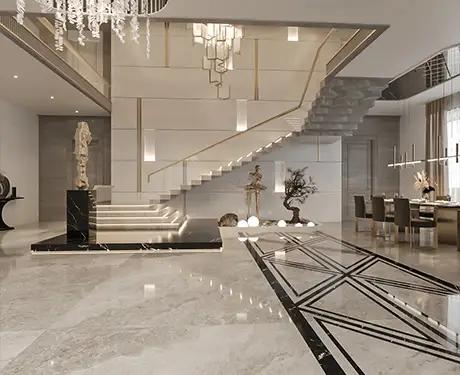
- Italian Marble vs. Indian Granite: While Italian marble is a favorite in luxury architectural designs, it is porous and prone to staining from the high mineral content in local water. For high-traffic areas, we often recommend high-quality Indian Granite or engineered Quartz. These are non-porous and handle the expansion caused by heat without cracking.
- Double-Charged Vitrified Tiles: For those who want the look of marble without the headache, these tiles are the gold standard. They are denser than standard ceramics, making them nearly impervious to moisture.
- SPC (Stone Plastic Composite) Flooring: If you love the look of wood, skip the traditional laminate. SPC is a hybrid material that offers the aesthetic of timber with the waterproof and heat-resistant properties of stone.
2. Wall Finishes: Combating Humidity and Dust
In Delhi-NCR, walls often suffer from efflorescence (white salty deposits) and dust accumulation. The right finish acts as a shield rather than just a color.
- Lime Plaster and Venetian Finishes: Unlike synthetic plastic paints that trap moisture and eventually peel, lime-based plasters are "breathable." They allow moisture to move through the wall, preventing mold growth during the humid monsoon months.
- PU and Polyester Coatings: Traditional spirit polish will crack in the North Indian heat. For cabinetry and wall paneling, we use PU (Polyurethane) or Polyester finishes. These create a hard, UV-resistant shell that stops wood from drying out and warping.
- Exterior Grade Laminates (HPL): For balconies or facades, High-Pressure Laminates (HPL) are essential. They can withstand direct UV exposure without fading or losing structural integrity.
3. Window Systems: The Barrier Against Heat and Noise
Your windows are the most critical thermal barrier. In a region where the AC runs for eight months a year, window efficiency directly impacts your electricity bills.
- DGU (Double Glazed Units): A hallmark of high-end architectural designs, DGU windows feature two panes of glass with a vacuum space between them. This significantly reduces heat transfer and cuts down the urban noise of the city.
- Thermal Break Aluminum Sections: Standard aluminum frames conduct heat. We utilize "thermal break" technology, where a non-conductive material is placed within the frame to stop outdoor heat from radiating into your living room.
4. Hardware: The Silent Survivors
It’s often the small things—hinges, handles, and kitchen hardware—that fail first. In NCR’s dusty conditions, choosing the right metal is vital.
- PVD Coating (Physical Vapor Deposition): For faucets and handles, look for PVD-coated finishes. This process creates a surface that is significantly harder and more corrosion-resistant than traditional chrome plating.
- SS 316 Grade Steel: While SS 304 is the industry standard, for outdoor fittings or areas near water tanks, SS 316 (Marine Grade) offers much better protection against the harsh minerals found in local water supplies.
Why Expert Consultancy is Non-Negotiable
Choosing the right materials is only half the battle; the other half is knowing how to install them. A "durable" material installed poorly will still fail. This is why Interia is considered the best interior design company in India—we manage the entire lifecycle, from material selection to technical execution.
Our interior consultancy services don't just provide a material list; we provide a "performance roadmap." We analyze the orientation of your home, the local soil conditions, and your lifestyle to curate a palette that is truly "Delhi-proof."
Build a Legacy with Interia
Your home is more than a sanctuary; it is one of the most significant investments of your life. Don't let the harsh NCR climate dictate the lifespan of your interiors. By combining world-class architectural designs with a scientific approach to material selection, Interia ensures that your home remains a masterpiece for years to come.
As the best interior design company in India, we are committed to transparency, technical excellence, and timeless luxury.
Frequently Asked Questions (FAQs)
Q1: Is wooden flooring a bad idea for Gurgaon apartments?
Not if you choose the right type. Avoid low-grade laminates. Opt for Engineered Wood or SPC (Stone Plastic Composite) which are designed to handle humidity fluctuations better than solid wood.
Q2: How can I prevent my exterior paint from fading?
Use paints with high UV-resistance ratings and light-reflective values (LRV). Lighter colors reflect heat and stay cooler, which prevents the paint film from expanding and cracking.
Q3: What is the most durable countertop for an Indian kitchen?
Granite remains the champion. However, modern Quartz has become a top contender because it is non-porous and available in a wider range of contemporary colors.